For obvious reasons, it’s getting harder and harder to work in sustainability and remain optimistic these days. But, just like in The Streets’ tune, try, we must!
So it was that we convened once again at the Grand Palais, for the “green backlash” edition of ChangeNOW, one of Europe’s biggest climate conferences. Since Microsoft made its “moonshot” pledge to be carbon negative by 2030 there in 2020, “change” has very much been the key word; indeed “climate change” has even become a banned expression in Trump’s America. Which at least partly explained why ChangeNOW had so many less sponsors this year… Microsoft (and Google) in particular.
Fortunately, they maintained a main stage conference slot for AI, and gave us 1 hours and 15 minutes to discuss its environmental and social impacts, versus 20 minutes last time 🙂 Better still: the line-up was fantastic, from the inimitable Sasha Luccioni (Hugging Face) to Salesforce’s climate boss Tim Christophersen, and from Data for Good/Ekimetrics’ Théo Alves da Costa (whose 2023 talk got me into AI sustainability in the first place) to clinical psychologist and neuroscientist Albert Moukheiber. Not forgetting ‘Chief Poetic Officer’ Vincent Avanzi‘s artistic interlude!

To what extent does this climate crowd know and care about this topic? Whilst almost everyone raised their hand when asked if they use AI tools, less than a third kept them up to indicate whether they knew about LLMs’ considerable environmental impacts (electricity consumption tripling, etc). But all those hands went back up to express interest in using AI more responsibly. Phew!
On to the speakers: after a rousing keynote from Luccioni, which called for Democratisation, Transparency and Accountability in order to move towards more frugal AI, the panel with her, Alves da Costa and Christophersen (featured image) focused both on problems and solutions. Perhaps one of the biggest changes since last year has been local communities rising up all over the US to block nearly $100bn in data centre construction projects (source: Data Center Watch); a clear example of people power bringing about concrete change.
For Luccioni, this is the sort of pressure that companies, the clients of ‘big AI’ (GAFAM, major AI labs and all others pushing way-too-large language models on us all) should be putting on providers right now. It doesn’t seem to be working yet, but it could if they team up in hundreds or thousands, said Luccioni, and threaten to leave if not given more transparent data on AI’s impacts. I.e. the corporate version of people power… Maybe not such a distant prospect, considering the increasing number of unhappy companies I’m currently hearing about.
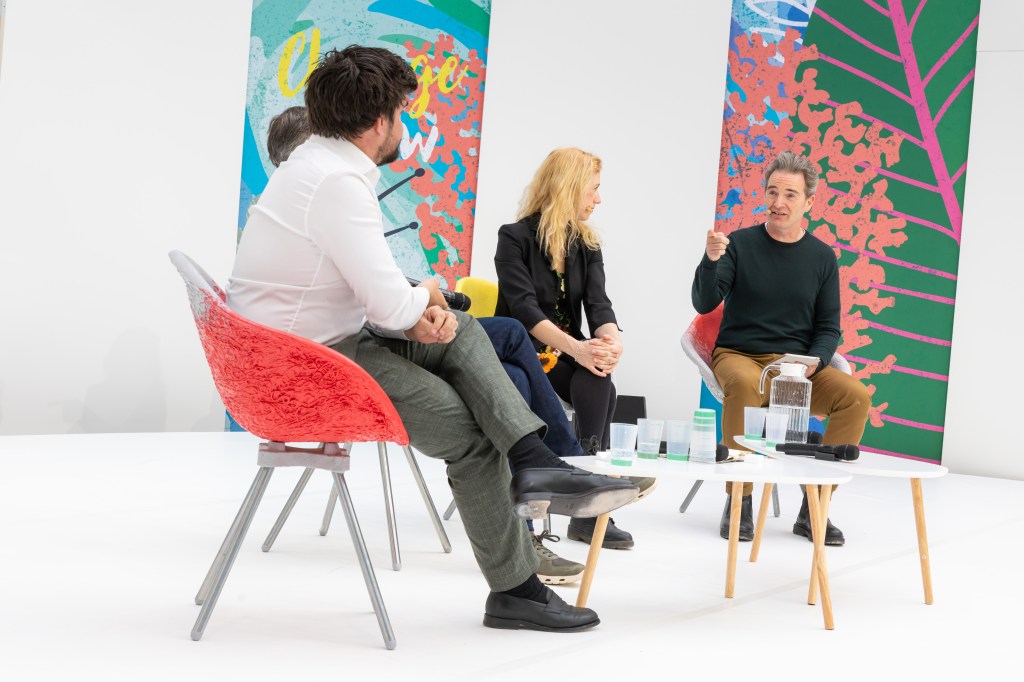
Alves da Costa (above left) expressed concern about the significant-chunk-of-Manhattan-sized data centre Meta is building in Louisiana, and the stress that is causing locals… like his own mother. This is notably why his ONG, Data for Good, is helping the community of Wissous, in the north of France, to fight back against Amazon’s plans to build a huge installation there. The world’s biggest cloud provider (AWS) is attempting to get around local regulations by only revealing the true size of the project bit by bit, as the data centre will ultimately so big, it would never be approved in one go. Such tactics are compounded by the now-common tendency of such companies to hide behind other names, so neighbours only find out at the last minute – in a darker version of Scooby Doo’s reveal moments – who is really behind these increasingly huge projects.
For Christophersen, it’s up to companies like his, clients of the major cloud and AI providers, to demand maximal transparency, to ensure such projects are socially and environmentally beneficial. This is why Salesforce insists on three key elements: clean supply (using the greenest possible data centres and electricity), smart demand (only using the requisite amount of AI compute power, and therefore resources, for the task in hand), and efficiency (working to ensure Salesforce’s own AI models consume as little energy per token as possible, for example).
“Let us poetise AI before it standardises us” was as such an apt appeal during Avanzi‘s poetic interlude…
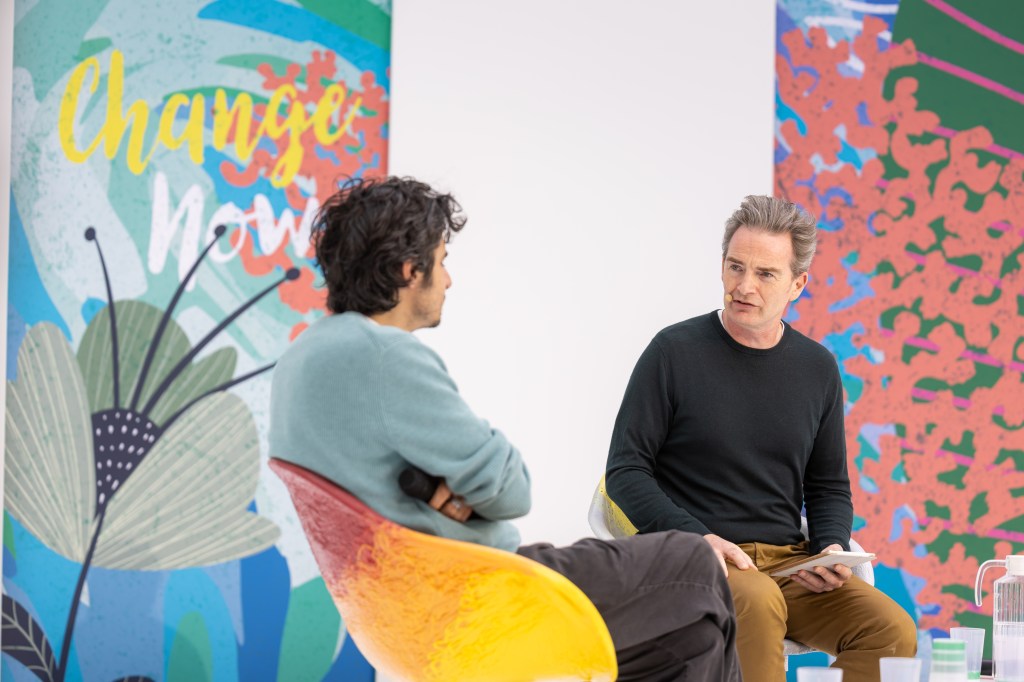
Then it was on to AI’s psychological impacts, with Moukheiber (above), who’s a bit of a star here in France, thanks to his knack for explaining the biggest psychological concepts to all sorts of audiences. Why, for example, are an increasing number of people (at least 600,000 ChatGPT users, according to OpenAI) getting sucked into delusional “spirals” by AI chatbots, who tell them they are the messiah and suchlike?
Because they fool our “epistemic vigilance“, as he put it. We trust all other technological tools, e.g. a ruler will always tell us the right measurement, said Moukheiber. But when a chatbot hallucinates (lies) or flatters us, we inherently trust it. Or rather, we are not equipped to mistrust it. His advice as such to people getting sucked into spirals, and/or to their friends and family? Don’t just take their phone or computer away. Encourage them to ask their chatbot to present the opposite argument, ie. they are not the messiah (they’re a very naughty boy! I couldn’t resist dropping a Month Python reference that literally noone got 🙄)
TL;DR: AI’s impacts are considerable and growing, but there are ways to counter them.
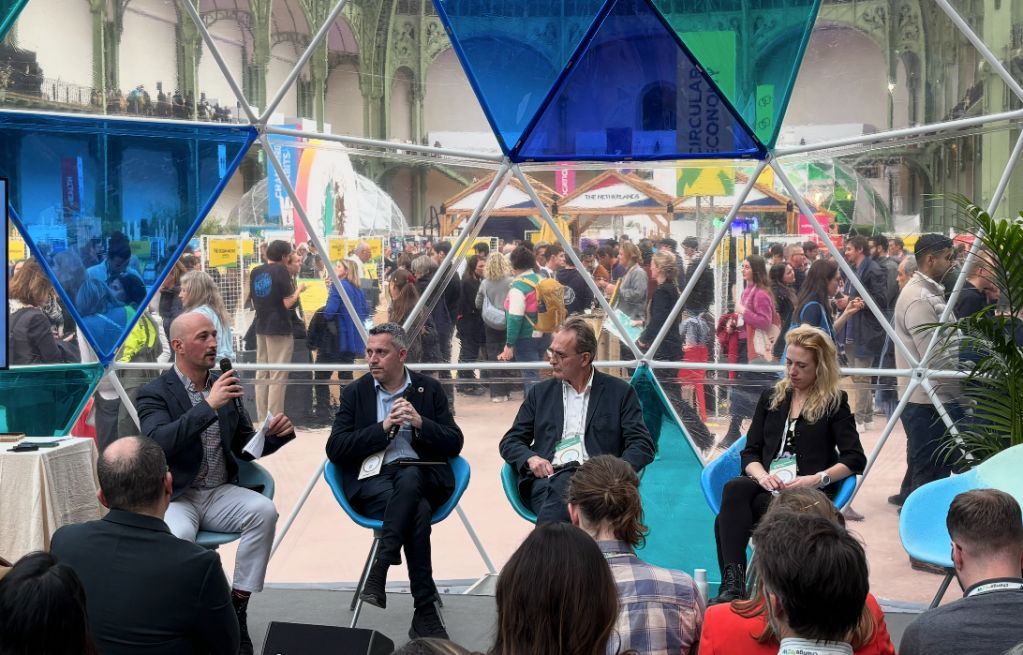
We could, for example, “ban general purpose AI models”, suggested Luccioni on Saleforce’s panel later in the day (above right), when asked by moderator Boris Gamazaychikov (Salesforce’s AI sustainability Leader, left) to express her greatest wish. Such models – which by far consume the most resources – could in theory be replaced by 20 or so smaller ones. Her work has indeed be insisting for years now that models at least hundreds of times smaller than today’s most-used ones could quite easily handle the most common requests they get. So whilst doing what Gemini and ChatGPT increasingly do – if it’s a simple question, it’ll be routed to a smaller model – is progress, it’s still akin to what I call using a bazooka to swat a fly. So let’s just start with the flyswatters in the first place!
Surprisingly, on the same panel, Google’s Adam Elman, head of sustainability for EMEA, agreed on the importance of “choosing the right model for your needs”. I fully agree, of course; but why not try to start meeting those needs with the smallest models first, rather than making users turn to the biggest ones beforehand?
Also on the panel was Christophe Lienard, CIO of massive French construction company Bouygues and president of an association called Impact AI. He shared some interesting figures, in advance from Impact AI’s barometer, due out in May, the result of interviews with a thousand employees of a range of companies. Whilst half of those employees use AI (at work, we presume this means), only 5-10% use it responsibly; only 23% say they are trained in responsible AI; and only 6% ‘deeply’ trained. “AI is moving faster than governance”, said Lienard; “we need to change that”. Also agreed!
Both Elman and Lienard also cited figures suggesting AI and data centres’ share of electricity and emissions was still small compared with other sectors. The real issue is that this share is growing way too fast. For example, data centres’ electricity demand tripled in 2025 alone in Virginia, home to most of the US’ installations, because of AI. This means cities like Dublin, Marseille or London increasingly have to choose between powering data centres or, say, electric buses, or people’s homes.
Somewhat less responsible is the growing trend of agentic AI; something not discussed onstage at ChangeNOW. I did however quite randomly meet a former (human) collaborator of Automonous, a company which uses agentic AI to create autonomous companies. What for? Well, they can do things like send emailing campaigns and other corporate standards autonomously, with human-in-the-loop intervention required only for crucial actions such as payments. I’m still not sure what the point of this, is, but the very fact it exists, and consumes tens of thousands more tokens – and therefore resources – than the biggest LLMs is something we should be concerned about.
Green figureheads’ counter-intuitive optimism
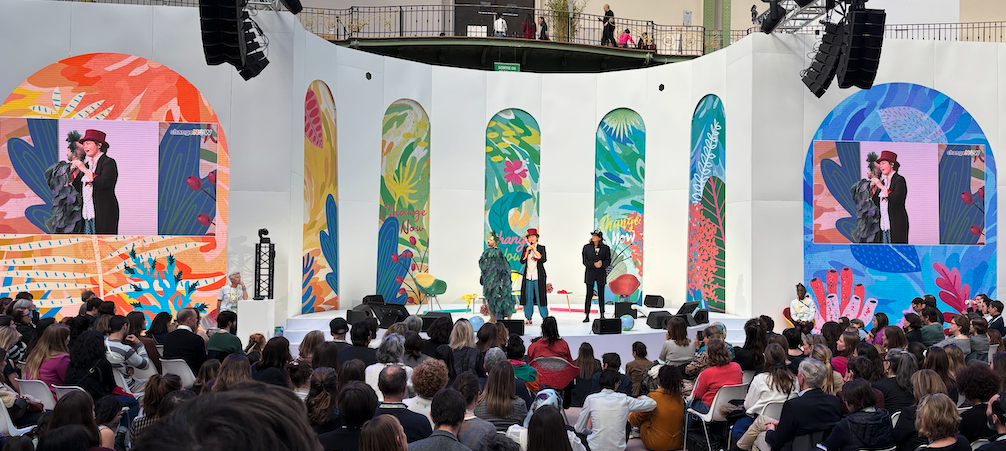
Moving on from AI, a more joyful trend emerging from ChangeNOW was seeing its star speakers jump into a playful and almost burlesque level of optimism. Kate Raworth, the economist who invented the sustainable theory of doughnut economics – in a nutshell, forget growth-at-all-costs and let’s focus on sufficiency – closed ChangeNOW’s first day with a circus-like show in which one audience member played mother nature, and another played finance. Raworth, the top-hatted ringleader, used playground props and audience interaction to illustrate the point that growth is “phallic” (one of those polystyrene swimming sausages illustrated a dogleg curve) and unsustainable, whereas mother nature’s same sausage was made into a circle. You get the gist.
As Raworth said on a panel the next day, she considers she’s done enough groundwork now – for example by establishing the Doughnut Economics Action Lab – for the “next crew” to be able to “take this to the next level. So let’s go to the circus!”
Could such playful illustrations of climate change’s perils be the way forwards? Rob Hopkins, who shared the stage with Raworth on day 2, would definitely agree. The founder of the Transition Towns movement is now a full-time author and speaker. His latest book, “How to fall in love with the future“, was inspired by a t-shirt he saw a few years ago, which said “I’ve been to the future. We won.” For Hopkins, imagining a better future is the best, or even the only way, to get through the climate crisis today.
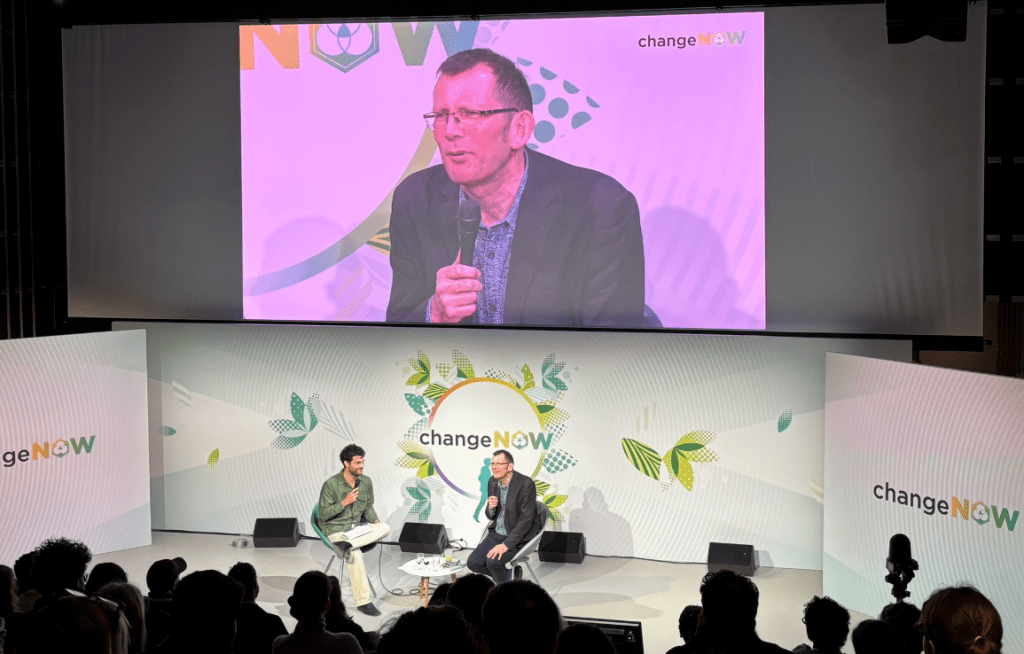
“If we present the race to decarbonise as charts and figures, who cares?” he told a live podcast session on day 2 (above). “We have to create longing. By 2036 we have to be halfway down that [temperature/emissions reduction] curve. The climate crisis demands that we rethink everything. That could be so exciting!”
Hopkins and Raworth also agree that the problem is not a lack of solutions; it’s a lack of action.
“What I’m doing is ‘evidence-based dreaming’,” said Hopkins. [The problem is] not a lack of innovation. Everything we need to do already exists. We just need more longing. Or, to quote Don DeLillo, “Longing on a large scale is what makes history“.”
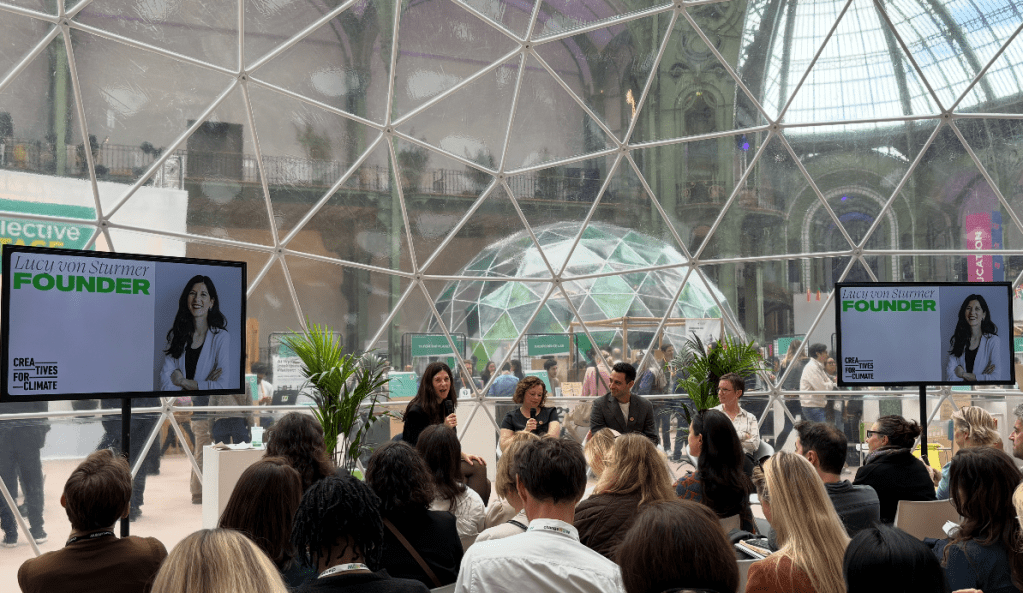
Another source of optimism vs. the prevailing doom came from Creatives for Climate, the ONG founded by Lucy von Sturmer (photo) to mobilise the advertising world to do their bit for the environment. CfC has come up with a Greenshouting Guide, sharing best-in-class cases of effective sustainable campaigns. French reconditioned tech marketplace Back Market’s Marie Castelli (right above) shared a few of those, including their “Obsolete Computer” campaign, in which they explained how to install ChromeOS Flex on your PC, saving it – and millions of others – from obsolescence when Microsoft decided to stop supporting Windows 10. That’s the way to do it!
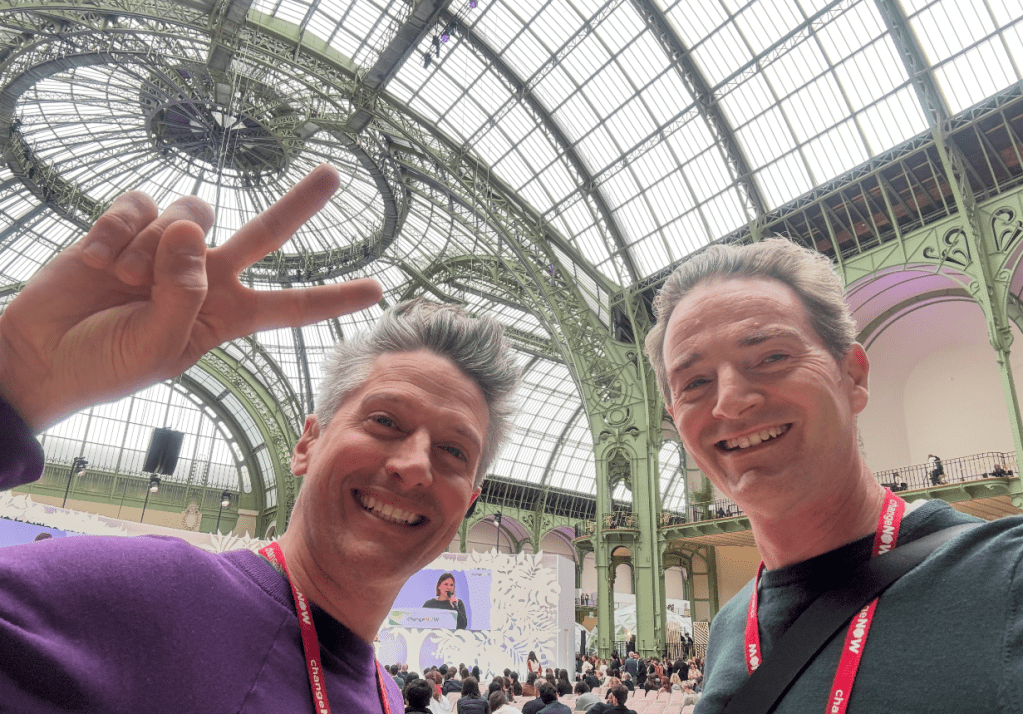
Last but definitely not least: ChangeNOW also had the good sense to invite climate comedian Stuart Goldsmith (above), whose work I strongly encourage you to check out, e.g. this full set from the Apollo. I won’t spoil any of the gags, but once again the key point is, as I remarked after Green IO, if we can’t laugh about (at least some of) this, 1/. we’ll never get through it, and 2/. we won’t be able to imagine a better future.
So next time you find yourself freaking out about the fate of our planet, do what Hopkins asked us all to do in that podcast session. Close your eyes, imagine the next ten years flying by, then step out of wherever you are and imagine what you’d long for it to look like in that near future. Bicycle motorways? Flowers growing everywhere? People actually smiling in the street? Anything goes. Now come back to the present. And do everything you can to make that ideal 2036 happen. Including laughing!
To take a deeper dive into Frugal AI and Responsible AI, look no further…
AI Panel photos © MARIE BRUNEL MARIE. N.B.: ChangeNOW’s AI only sends you the photos in which it can see your face. Whence the backs of everyone else’s heads…
All other photos: mine 🙂

 BetterTech