This year, a big first: I spoke at ChangeNOW, one of the world’s biggest climate events (c. 40,000 visitors/year). On the impact of AI, my fave topic du jour (unless you hadn’t noticed).
Naturally, I was happy to get my key points across – with the help of ace moderator Kristen Davis (above right) – namely the indisputable facts about AI’s impact (somewhat elusive facts when the sector’s $300 billion giant, OpenAI, won’t disclose its own impact data, instead gaslighting the “anti-AI crowd” for “making shit up“. “If you’re listening, Sam, show us the figures!” exclaimed my co-panelist, Axelle Lemaire, Head of Corporate Responsibility and Sustainable Development for IT consulting giant Sopra Steria, above centre). What we can say for sure:
- 500,000 smartphones could have been recharged with the energy it took to generate one image each for the 1 million people who joined ChatGPT in one hour for those questionably-legal Ghibli-style images (the “half a smartphone charge per image generated” estimation comes from Sasha Luccioni et al’s 2024 white paper),
- However, as AI impact varies hugely per territory worldwide, it’s more accurate to focus on the macro-trends, namely:
- Data centre energy consumption will double-to-triple by 2028 earliest, 2035 latest
- Data centre water consumption will triple-to-quadruple in the same timespan (sources all here, still)
- (I didn’t get time to say this, but) Elon Musk’s Grok supercomputer data centre in Memphis uses 5 million litres of water per day – source – and runs off 35 methane-powered generators, 20 of which are unauthorised (source)
- AI-related ewaste is set to increase x1000 by end of decade (source) – hardware, not emissions, is by far tech’s biggest impact
- 5 times more energy per rack will be consumed by the GPUs set for release in 2027 than by NVIDIA’s current-generation chips; ergo the “bigger is better” race driving AI’s spiralling impact – and market value – is not set to stop
- Surging demand for AI is slowing down the energy transition: ⅓ of what Trump calls the US’ 400 “beautiful, clean” coal plants are to be unretired to meet AI’s demands, because nuclear power stations take at least 10 years to build.
All of which smacks of the same sort of BS as Microsoft’s claim – notably made at ChangeNOW 2020! – that it would be “carbon negative” by 2030; its now-infamous “climate moonshot”. Last year, M$ president Brad Smith was forced to admit that the moon had “just got 5 times further away” because his company had missed its emissions reduction target – up 29% vs 2020 – due to AI. Talk about shirking responsibility…

Especially when we talk about rebound effects, like the fact that Microsoft AI enabled emissions 3-4 times higher than its own with just two petrol projects, for Chevron and ExxonMobil (I was glad to be able to mention this shocking discovery from former M$ AI engineer Will Alpine; more on that here).
Fortunately, not all big companies are chasing the “bigger is better” AI dragon. Axelle Lemaire – previously France’s digital minister – agreed that power consumption is soaring out of control (she even said DC consumption is set to quadruple), and that we need to encourage more frugal uses of AI.
My thoughts exactly: I notably recommended the use of measurable open source AI models; of lower-carbon EU data centres; and of impact measurement tools like GenAI Impact’s Ecologits.ai.
Unfortunately, Lemaire didn’t have time to talk about Ecomind AI, Sopra Steria’s tool for measuring impact, as our 20 minute panel was cut at least 3 minutes short, apparently because the previous panel had overrun. So we left the stage happy, but frustrated.
The other panels of our 1 hour 30 min “AI for Impact” slot had largely praised AI’s ‘magical’ potential to speed up medical research (though GSK France boss Thibault Desmarest wouldn’t say by how much; but he did say AI was enabling his company to use 28% less water, somehow); or to create 40 million new jobs by the end of the decade (yes, Microsoft’s Anthony Virapin really said that); or to improve social protection, according to Bayes Impact’s Elodie Juan-Julia.
More concrete was Shani Gwin, founder of pipikan pêhtâkwan, who explained how she is using generative AI to preserve the traditional stories of First Nation Canadian tribes, versus the colonial version of her people’s history. Why? Because if you ask Google’s Gemini AI, it gives the latter, not the former. So at least by using a more open model – Meta’s Llama, in this case – Gwin’s solution relies on more accountable AI.
In short, less than a quarter of the stage time ChangeNOW had chosen to devote to “AI for Impact” was focused on the impact of AI. Strange for a climate conference, happening on the 10th anniversary of the Paris Agreement, in the iconic Grand Palais, non?
Watch the full session here: ours (with Axelle Lemaire) starts at 57 minutes:
Other examples were to be found here and there, for example in a Frugal AI workshop, sponsored by Sopra Steria – so not a ChangeNOW initiative – with the excellent Juliette Fropier of France’s Environment Ministry, who’s leading the nation’s charge to become a frugal AI pioneer; or in a debate closing the B2B part of the conference, on the motion “This house believes that AI will regenerate us“. Fortunately, the “against” team won it by clapometer, suggesting a majority of ChangeNOW’s audience is sceptical that AI can be a net positive for the planet. Phew…
This scepticism didn’t, however, seem to be shared by many of ChangeNOW’s other paid conferences – again, not chosen by the ChangeNOW team itself – which professed that AI could help crisis management (re. The Red Cross), improve biodiversity (re. Darwin Data) or improve supplier engagement strategy (re. EcoAct). Oh and of course, Microsoft, which held a workshop on how generative AI can improve ONGs’ impactfulness, justement…
Perhaps, but at what cost?
Similarly, the startups exhibiting in the “AI for Impact” zone were a mixed bag, mostly focused on the notion of analysing satellite images with AI to help further projects such as reforestation (e.g. Kanop, or Space4Good). Which is great, of course. But are they using more frugal AI models? They couldn’t say.
The “movie star” syndrome
At the end of ChangeNOW’s two B2B days, it would seem that AI, the most-hyped topic of the moment, had fallen into the event’s now-infamous trap: is ChangeNOW about changing the world, or is it about letting its biggest sponsors do their greenwashing in public? As voices arose online as to why the event hadn’t been more critical of AI’s impact, we could wonder if it hadn’t fallen for the “movie star” syndrome.
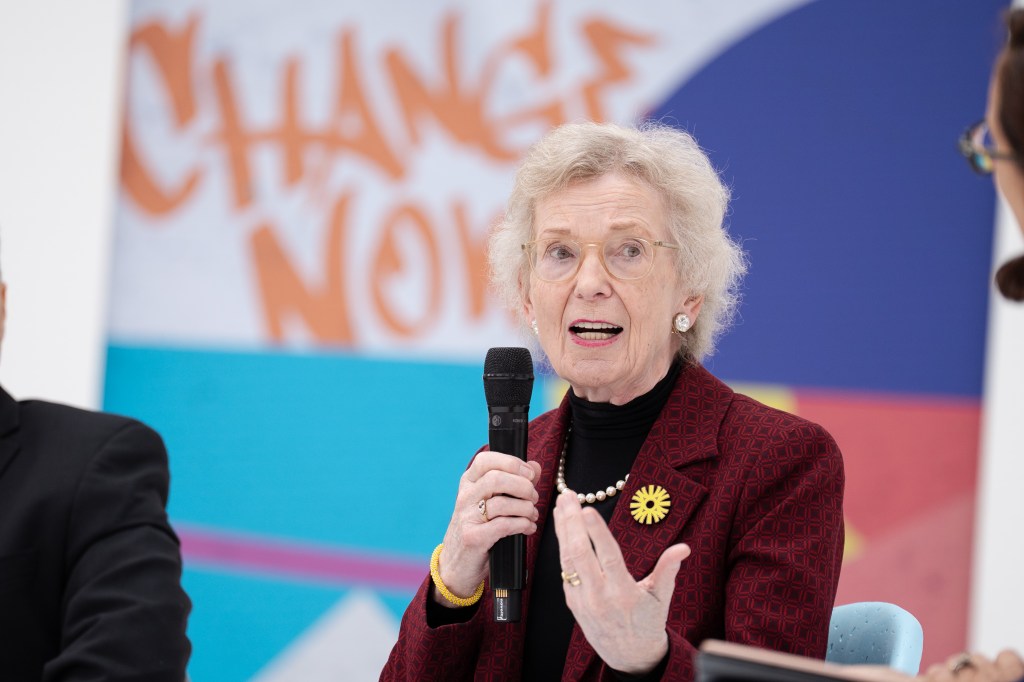
As former Irish president – and one of my climate heroines, as the main inspiration behind the leader of the fictitious Ministry for the Future – Mary Robinson (above) put it at the event’s opening panel, in the 10 years since the Paris Agreement, there has been “too much greenwashing, too many big announcements with movie stars, not enough accountability or focus on the biggest polluters. We’ve got to be ambitious“, she said (P.S.: lo and behold, ChangeNOW 2025 would end the next day with movie star Natalie Portman…)
“We learned from the Paris agreement the difference between greenwashing and green acting”, agreed French politician Laurent Fabius, president of the COP 21 conference. “Now it’s time to implement and to check. We need an institution capable of checking whether governments are doing what they promised. It’s all about implementation.”
Seeds of hope
Fortunately, some more radical voices at ChangeNOW gave hope that concrete change was possible. Maren Costa (below) first and foremost told of how, after nearly 15 years as an Amazon UX designer, she got sick of pushing consumers towards ever-more consumerism, and formed a group of colleagues concerned about the environment.
One day, she called for Amazon warehouse and tech workers to walk out together for the very first time. Some 1500 tech workers accepted the invitation. Within two hours, those emails were deleted, the invitations removed from all those calendars, and Costa was fired. Now an advisor to WorkforClimate, she stands alongside activists such as former Microsoft employees Will and Holly Alpine (cf. above) and Drew Wilkinson in encouraging tech workers to stand up against their leaders’ rampant disregard for the planet. Find out more in the stunning Netflix documentary Buy Now! The Shopping Conspiracy, in which Costa is the central interviewee.
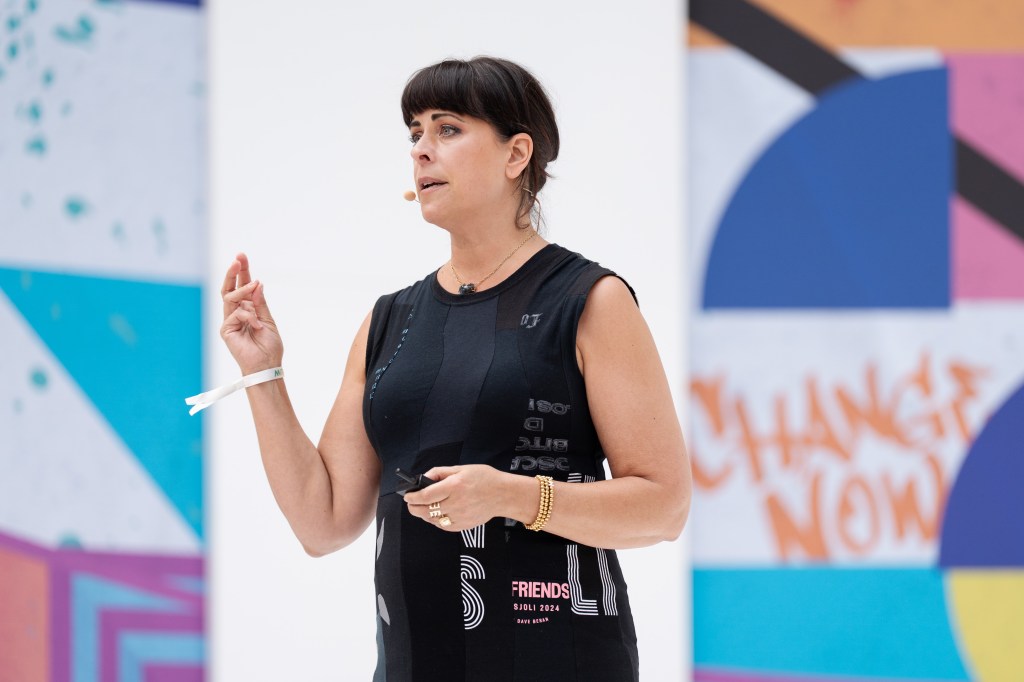
So how can we keep communicating the right messages, especially now words like “climate” are effectively banned in the US? Enviral’s Joss Ford offered one pathway, on the “Climate communication – from information to action” panel: “let’s focus on a shared objective like “Wellbeing for all, forever.” How could you not agree with that?”
In any case, we mustn’t “rely on scientists to communicate” on these topics, said… climate scientist Mark Maslin. “We need communicators!” Nor, he suggested, can we rely on politicians. “The right has made even 15-minute cities sound bad. Who wants a longer commute?! Politicians saying they understand climate change, but can’t afford to deal with it now, is the worst form of climate denialism. We just need to talk about the money. For example, why not invest trillions in renewables instead of in fossil fuels?” It’s that simple, Maslin seemed to suggest.
Indeed, as Robinson had put it earlier, “during Covid, we found one trillion dollars because we were in a crisis,” added Robinson. “Why can’t we understand we’re in a crisis now? Nature doesn’t stop for wars. We need to get our politicians into climate mode.”
Perhaps it does all come down to responsible and accountable leadership. Coming back to AI to conclude, as debater Fatou Thiam of McKinsey put it, “I asked ChatGPT if AI could regenerate us. It said “yes; if it is guided with wisdom and care”. So then I asked it if previous tech revolutions had been guided with wisdom and care. It said “no”! So how will AI be any different? Whose glasses of water are being taken away with our queries?”
I rest my case. For now!

 BetterTech